How Much Concrete Do I Need? Slab, Footing and Post Hole Formulas
Posted by Home DIY Online Editorial Team Posted Topic: Outdoors
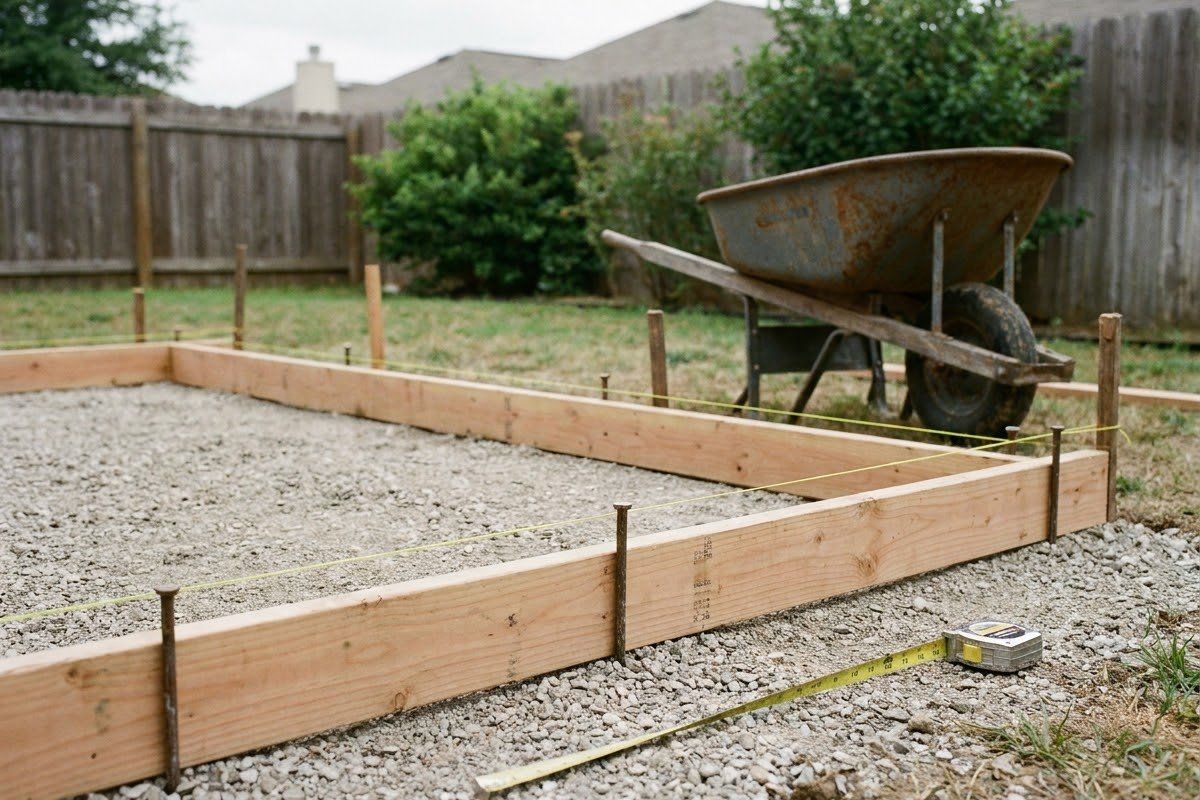
To work out how much concrete you need, find the volume in cubic feet (slab: length x width x thickness in feet), add about 10 percent for waste, then divide by the yield on the bag. Quikrete and Sakrete list 0.6 cubic feet per 80 lb bag, so a 10 x 10 ft slab 4 inches thick needs about 62 bags, or 1.4 cubic yards.
Covered in the guide: How to Build a Deck: Permits, Footings, Framing and Finishing
How much concrete do you need?
Find the volume in cubic feet, add a waste allowance, then divide by the yield printed on the bag. For a 10 x 10 ft slab 4 inches thick that is 33.3 cubic feet, 36.7 with 10 percent extra, and 62 bags of 80 lb mix or about 1.4 cubic yards for ready-mix.
Concrete is the first thing to price on most outdoor builds, from footings in the deck building guide to a patio or a fence line. The concrete calculator does these sums for you; the formulas below show where the numbers come from.
How do you calculate slab volume?
Multiply length by width by thickness, with all three in feet. Divide the thickness in inches by 12 first.
- Slab: length (ft) × width (ft) × thickness (in ÷ 12)
- Example: 10 × 10 × (4 ÷ 12) = 33.33 cubic feet
Quikrete’s bag calculator offers 4 inch and 6 inch slabs, which is a useful range for a patio, though the right thickness for your job depends on use and local code. A 6 inch slab of the same size needs half as much again.
How do you calculate footings and piers?
A footing is a long, narrow slab, so use run × width × depth. A round pier or post hole is a cylinder: π × radius² × depth.
- Strip footing: length (ft) × width (ft) × depth (ft)
- Round hole: 3.14 × (diameter ÷ 2)² × depth, all in feet
Footing size for a deck comes from your plans and code, not from this page. The deck guide explains the tables, and the fence installation guide covers post depth for fences.
How much concrete does a post hole take?
Quikrete’s Fast-Setting data sheet says a post hole should be 3 times the post diameter and as deep as one-half of the post height above ground. A 4x4 post (3.5 inches actual) in a 10.5 inch hole that is 36 inches deep holds about 1.8 cubic feet, a little over three 80 lb bags. Holes deeper than 30 inches should be filled in lifts of 30 inches or less. Multiply by the number of posts and add your allowance.
How many bags are in a cubic yard?
A cubic yard is 27 cubic feet. Divide by the yield on the bag.
| Bag size | Yield per bag | Bags per cubic yard |
|---|---|---|
| 40 lb | 0.3 cu ft | 90 |
| 60 lb | 0.45 cu ft | 60 |
| 80 lb | 0.6 cu ft | 45 |
Quikrete and Sakrete list the same yields for their standard mixes. Fast-setting, high-strength and specialty mixes can differ, so use the number on your bag. Past about a cubic yard, ready-mix delivery is worth pricing against hand-mixing dozens of bags.
How much waste should you allow?
Add an allowance, because Quikrete’s yields are approximate and allow nothing for an uneven base or waste. Ten percent is a common planning figure and not a manufacturer number. Over-dug holes, spillage and a rough subgrade all use more, so raise it for a first pour.
Worked example: a 10 x 10 ft patio slab
- Volume: 10 × 10 × 4 ÷ 12 = 33.33 cu ft
- With 10 percent: 33.33 × 1.10 = 36.67 cu ft
- Cubic yards: 36.67 ÷ 27 = 1.36 cu yd
- 80 lb bags: 36.67 ÷ 0.6 = 61.1, so 62 bags
- 60 lb bags: 36.67 ÷ 0.45 = 81.5, so 82 bags
- 40 lb bags: 36.67 ÷ 0.3 = 122.2, so 123 bags
Without the allowance the same slab needs 56 bags of 80 lb mix.
What about the base and ordering ready-mix?
The calculator counts only the concrete. A compacted gravel base is a separate quantity: use the gravel, mulch and topsoil guide to size it. Reinforcement, forms and curing supplies depend on your plans. When you order ready-mix, give the supplier the cubic yards with your allowance and ask about minimum loads and delivery fees. For more projects that start with a pour, see patio pavers on a DIY budget, outdoor steps and durable hardscape projects.
Questions we get
How many 80 lb bags of concrete make a cubic yard?
A cubic yard is 27 cubic feet, and Quikrete and Sakrete list 0.6 cubic feet per 80 lb bag, so a yard is 45 bags (27 divided by 0.6). With 60 lb bags it is 60 bags, and with 40 lb bags it is 90. Every real bag count rounds up, and the yields are approximate, so order a little more than the math gives.
How thick should a patio slab be?
It depends on the use and on local code. Quikrete's own bag calculator offers 4 inch and 6 inch slabs, and its Concrete Mix is for pours 2 inches thick or more. For a driveway, a shed floor or anything carrying vehicles, follow your plans and ask your building department before you pour.
How much extra concrete should I order?
Add a waste allowance. Quikrete says its yields are approximate and allow nothing for an uneven base or waste. Ten percent is our planning default and not a manufacturer figure; raise it for rough ground, over-dug post holes or a first pour. Ready-mix is ordered by the cubic yard, so ask the supplier how much extra they advise.
What is the difference between cubic feet and cubic yards?
A cubic yard is 3 ft by 3 ft by 3 ft, or 27 cubic feet. Bags are sold by cubic feet of yield and ready-mix trucks by cubic yards, so divide cubic feet by 27 to convert. A 10 x 10 ft slab 4 inches thick is 33.3 cubic feet, or 1.23 cubic yards before any waste allowance.
How much concrete is in a 4x4 post hole?
Quikrete says the hole should be 3 times the post diameter and as deep as half the post height above ground. A 4x4 post is 3.5 inches actual, so the hole is about 10.5 inches across, and 36 inches deep it holds about 1.8 cubic feet, a little over three 80 lb bags per post. Holes deeper than 30 inches should be filled in lifts of 30 inches or less.
Where we got this
- Quikrete, Concrete Mix No. 1101 data sheet: yield by bag size (quikrete.com)
- Sakrete, High-Strength Concrete Mix technical data sheet: yield by package size (sakrete.com)
- Quikrete, Concrete Calculator (4 inch or 6 inch slab; yields approximate, no allowance for waste) (quikrete.com)
- Quikrete, Fast Setting Concrete Mix No. 1004-60 data sheet: setting posts and yield (quikrete.com)
- Texas A&M AgriLife Extension, Travis County: How Much Compost, Soil or Mulch? (27 cubic feet per cubic yard) (travis-tx.tamu.edu)
Keep reading
- How to Build a Deck: Permits, Footings, Framing and Finishing
How to build a deck step by step: permits, footings, ledger flashing, fasteners and treated lumber ratings, based on the AWC DCA 6 prescriptive guide.
- Gravel, Mulch and Topsoil: How to Calculate Cubic Yards, Tons and Bags
Calculate cubic yards, tons and bags of gravel, mulch or topsoil: the area x depth formula, density table, bag counts and a worked 100 sq ft mulch bed.
- Grilling Tool Sets Compared: Five Sets, Specs From the Makers
Compare five grilling tool sets from Weber, Cuisinart, Grillaholics, All-Clad and OXO by maker specs, plus what to check before you buy.
- Pressure Washers Compared: Five Models and Their Maker Specs
Compare five pressure washers from Snapper, Simpson, Ryobi, Westinghouse and Sun Joe by maker specs, with injury and recall safety you need.
- Yard Drainage Solutions: How to Fix Standing Water
Fix a wet yard: find the water source, grade 6 inches in 10 feet away from the house, then add swales, a French drain or a dry well where needed.
- How to Build a Garden Path: Materials and Steps
How to build a garden path: pick a width and material, lay it out, prepare the base, add edging and drainage, with extension and paver-maker sources.