Multi-Purpose Storage Furniture for Small Spaces
Posted by Home DIY Online Editorial Team Posted Revised Topic: Storage
Multi-purpose storage furniture does two jobs at once, such as a bench that holds shoes, a coffee table that lifts to show storage or a bed with drawers. It suits small homes because it adds storage without more floor space. Choose pieces by what you need to store, check the maker's load rating, and anchor any tall or drawer piece to the wall.
Covered in the guide: Garage Storage Ideas: Wall, Ceiling and Shelving Systems That Work
Multi-purpose storage furniture is furniture that does a second job as storage, so a small room holds more without more pieces. This page covers the household side of storage: benches, tables, ottomans, beds and cabinets that hide things. For tools and workshop gear, see the garage storage guide, which this page supports.
What kinds of dual-function furniture are there?
The main types are storage benches, lift-top tables, ottomans, beds with drawers and cabinets that double as seating or a desk.
| Piece | Stores | Best place |
|---|---|---|
| Storage bench | Shoes, bags, blankets | Entry, mudroom, end of bed |
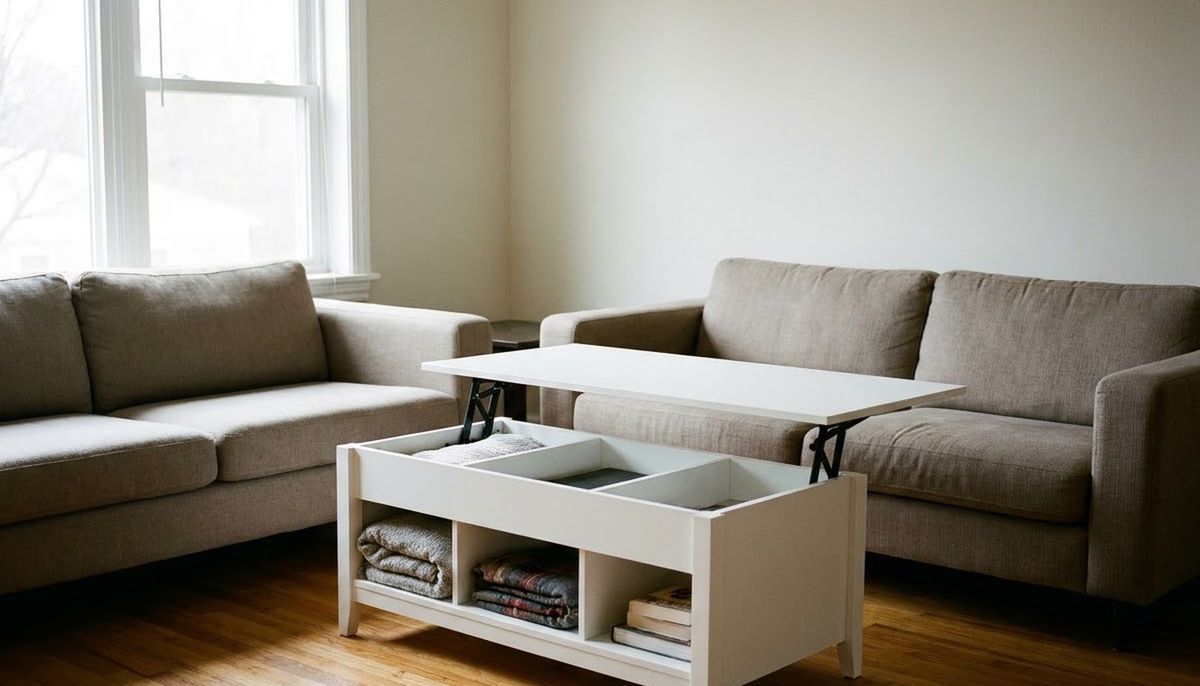
| Lift-top coffee table | Remotes, throws, games | Living room |
| Storage ottoman | Blankets, toys | Living room, bedroom |
| Bed with drawers | Off-season clothing, linens | Bedroom |
| Console or media cabinet | Media gear, board games | Living room |
How do I choose the right piece?
Choose the piece that fixes your biggest clutter problem and fits the room. Measure first, and check what you will store.
- List the items that are cluttering the room.
- Measure the wall or floor space, and the doors the piece must pass through.
- Check the maker’s listed load rating for the lid, shelf or drawer.
- Check how the lid or drawer opens: you need clearance for it.
- Choose finishes you can clean.
Which pieces suit entries and mudrooms?
A storage bench by the door holds shoes and bags and gives you a place to sit. Put hooks above it for coats. For more entry ideas, see behind-the-door storage and quick-access storage.
Which pieces suit living rooms?
A lift-top coffee table or storage ottoman hides clutter in plain sight. A low media cabinet holds gear and games. Choose a lift mechanism that holds the lid up and does not drop on fingers. For dead corners and awkward spaces, see corner storage and under-stairs storage.
Which pieces suit bedrooms?
A bed with drawers or a lift-up base stores off-season clothes and linens. Check that drawers or the lift have enough clearance. For long-term bulky items, see seasonal storage.
Do I need to anchor storage furniture to the wall?
Anchor tall furniture and anything with drawers to the wall. This is the most important safety step with storage furniture.
The CPSC’s Anchor It campaign advises securing TVs and furniture such as bookcases and dressers to the wall, and says the campaign contributed to a nearly 50 percent decline in tip-over-related injuries and deaths. It notes that the STURDY Act dresser standard took effect in September 2023. Where anchoring is not possible, it advises putting TVs on a stable, low base, keeping heavier items on lower shelves and keeping things that tempt children to climb off high spots.
IKEA says furniture must be securely attached to the wall. Its guidance lists a wood stud screw for drywall over studs, a plug with screw for drywall without a stud or for solid masonry, and toggle-style anchors for hollow masonry. If you are unsure, ask a hardware store. Use the restraint supplied with the furniture.
What should I not store in furniture?
Do not store anything hazardous or flammable in living-area furniture. Paints, fuels, solvents and chemicals belong in a proper storage area; see storage for hazardous materials. Also avoid heavy tools in a bench seat, and keep sharp tools out of reach of children.
Can I build my own storage furniture?
Yes, a storage bench, a lift-top box or a simple cabinet is a good beginner project. Start with straight lumber or plywood, glue and screws, and a hinge or lid support that holds the lid open safely.
- See building custom shelving for the shelf joinery.
- See build vs. buy storage cabinets to decide.
- See DIY space-saving storage projects under $100 for small builds.
- For a flexible system, see modular storage systems.
Tool storage is different from household storage. For a work area, see the tool station layout guide and how to organize hand tools.
How big is the tip-over risk with storage furniture?
Tip-overs injure thousands of people a year, and children are the most common victims. The CPSC reports that U.S. emergency departments treated an average of 17,800 tip-over injuries a year from 2020 to 2022, and that 44 percent of the victims were under 18. For 2013 to mid-2023 it counts 217 tip-over deaths, 71 percent of them children aged one to three, and says most involved TVs and furniture.
That matters here because many storage pieces are tall, drawer-based or top-heavy once loaded. A dresser, a bookcase and a media cabinet all fall in the category the CPSC asks you to anchor.
What does the federal dresser standard cover?
The standard covers dressers and other clothing storage units, and it took effect on September 1, 2023. The CPSC voted on April 19, 2023 to adopt ASTM F2057-23 as a mandatory federal safety standard for dressers and other clothing storage furniture, according to IKEA’s stability page. The Anchor It campaign gives the same September 1, 2023 effective date.
Two practical points follow from this:
- The standard applies to clothing storage units. A bed with drawers, a bench or a lift-top table is a different product, so do not assume it was built to that standard.
- A compliant piece is still safer when anchored. IKEA, which designs to the standard, says the best way to avoid tipping accidents is to anchor the furniture to the wall.
What stability features should I look for?
Look for features that limit how far or how many drawers open at once, and use them together with a wall anchor. IKEA’s stability page lists the following features on its own storage furniture:
| Feature | What it does |
|---|---|
| Drawer interlock | Lets only one drawer open at a time |
| Anchor and unlock | Lets several drawers open at once only after the unit is anchored to the wall |
| Shortened drawer extension | Reduces how far a drawer pulls forward |
| Supporting feet | Built-in feet that help prevent tipping |
| Forward-extended base | Extends the base to counteract tip-over |
IKEA is clear that these features are not a replacement for anchoring. Use the same logic when you shop for any brand: read the product page for the stability features and the anchoring hardware it includes.
How do I anchor a dresser, cabinet or bookcase?
Use an anti-tip kit with a stud finder, a drill and a screwdriver, and tug-test the strap afterward. The Anchor It campaign lists these tools and the following steps for installing a furniture or TV kit:
- Attach one bracket to the wall. Use a stud finder to locate a stud where you can, and choose the wall hardware that matches your wall type (see the IKEA hardware list above).
- Move the furniture close to the wall.
- Attach the other bracket or plate to the furniture or TV.
- Connect the strap to both brackets.
- Tighten the strap and check that it is secure.
- Tug on the strap to confirm the installation holds.
Anchoring uses small holes. The campaign advises repairing anchor holes in the wall when you move, rent or redecorate. If you rent, check your lease before you drill.
What if I cannot anchor the furniture?
Reduce the risk with placement and loading. The CPSC says that if anchoring is not possible, you should put a TV on a sturdy, low base and push it back as far as possible. Keep cords out of reach, keep heavier items on lower shelves, and avoid storing tempting items such as toys and remotes on higher shelves, because children climb to reach them.
This is a fallback, not an equal substitute. The Anchor It campaign’s key message is that anchoring all furniture with drawers, doors and shelves to the wall prevents tip-over injuries and deaths.
Are storage benches and chests with hinged lids safe for children?
A hinged lid can fall on a small child, so choose a lid that cannot drop freely or has no lid at all. When the CPSC proposed a rule on toy chest lids in 1982, it reported at least 21 deaths and one case of permanent brain damage since 1973 from lids falling on young children. Most victims were 10 to 12 months old, and the agency said trunks, footlockers and blanket chests with hinged lids may pose a similar risk.
The CPSC’s recommended lid features for chests:
- No lid. Open chests and bins are the safest option.
- Removable lid. A lightweight lid that comes off completely.
- Sliding doors or panels. These remove the falling-lid risk.
- Lid supports. A support that holds the lid in any position helps, because closing it takes deliberate force. Adjustable supports need regular tightening to keep working.
- A lid that falls freely. The CPSC advises removing the lid entirely if the chest has one.
The release is from 1982, so treat it as the agency’s description of the hazard and the design fixes, not as a statement about any current product. If a storage bench or ottoman in your home has a heavy hinged lid and children live in or visit the home, add a lid support that holds the lid open, or swap the lid for a lightweight removable one.
How should I check a piece before I buy it?
Check the product page and manual for these items before you pay:
- Does the maker list the anti-tip hardware, and is it included in the box?
- Is the piece a clothing storage unit that states it meets the federal stability standard?
- For a chest, bench or ottoman, does the lid have a support that holds it open, or is it removable?
- Is there a stated load limit for the lid, shelf or drawer?
- Will the piece fit through your doors and leave room for the lid or drawers to open?
If a listing does not answer these questions, ask the seller or choose a different piece.
Questions we get
What is multi-purpose storage furniture?
It is furniture that serves a second purpose as storage while doing its main job, such as a bench with a hinged seat, a coffee table with a lift-top, an ottoman with a hollow base or a bed with drawers. It helps small homes because the storage uses space the furniture already occupies. Look for sturdy hinges, smooth slides and a clear load rating from the maker.
Which dual-purpose furniture is best for a small apartment?
Start with the piece that fixes your biggest clutter problem. A storage bench by the door handles shoes and bags, a lift-top coffee table holds remotes and blankets, and a bed with drawers holds off-season clothes. Pick pieces sized to your room and avoid tall units that crowd walkways. Measure the space and the door first.
Do I need to anchor storage furniture to the wall?
Yes for tall pieces and any chest of drawers, bookcase or cabinet. The CPSC's Anchor It campaign advises securing TVs and furniture such as bookcases and dressers to the wall. Use the restraint that comes with the piece and hardware suited to your wall. Low benches and ottomans do not usually need it, but follow the maker's instructions.
How do I anchor furniture to different walls?
Match the hardware to the wall. IKEA's guidance lists a screw driven straight into a wood stud for drywall over studs, a plug with screw for drywall without a stud or for solid masonry, and toggle-style anchors for hollow masonry. If you are unsure of your wall type, ask a local hardware store. Use the restraint supplied with the furniture.
Is it safe to store heavy things in a storage bench?
Only up to the maker's stated limit, and not for anything hazardous. A bench seat that also carries people has a seat rating, so check the product listing. Keep paints, fuels and chemicals out of living areas and store them as described in our hazardous materials guide. Heavy tools belong in a workshop cabinet, not a bench.
Can I build my own storage furniture?
Yes, a storage bench, lift-top box or cabinet is a good beginner project. Use straight lumber or plywood, glue and screws, and a hinge or lid support that holds the lid open safely. Add a soft-close or lid stay if children are around. Anchor tall pieces to the wall, and see our shelving and cabinet guides for the build steps.
Do dressers have to meet a federal stability standard?
Yes. The CPSC adopted ASTM F2057-23 as a mandatory federal safety standard for dressers and other clothing storage furniture, and the Anchor It campaign says the rule took effect on September 1, 2023. The standard does not remove the need to anchor. IKEA, which designs to it, says the best way to avoid tipping accidents is to anchor the furniture to the wall.
What can I do if I cannot drill into the wall?
Lower the risk with placement and loading. The CPSC advises putting a TV on a sturdy, low base and pushing it back as far as possible, keeping cords out of reach, putting heavier items on lower shelves and keeping toys and remotes off high shelves. These steps help but do not replace anchoring, so ask a landlord about approved anchor options.
Are chests with hinged lids a risk for toddlers?
They can be. The CPSC reported at least 21 deaths and one case of permanent brain damage from toy chest lids falling on young children between 1973 and 1982, mostly babies aged 10 to 12 months. It recommends no lid, a removable lid, sliding panels or a lid support that holds the lid in any position, and says to remove a lid that falls freely.
Where we got this
- CPSC Anchor It! campaign marks 10 years (anchorit.gov)
- IKEA: Secure it! (furniture wall-anchoring guide) (ikea.com)
- CPSC: Anchor TVs and Furniture Before Super Bowl LX (tip-over statistics and tips) (cpsc.gov)
- IKEA: Innovation in stability (federal standard and stability features) (ikea.com)
- Anchor It! (CPSC): how to install an anchoring kit (anchorit.gov)
- CPSC: Proposes rule for toy chest lids (1982) (cpsc.gov)
Keep reading
- Garage Storage Ideas: Wall, Ceiling and Shelving Systems That Work
Garage storage ideas for walls, ceilings and shelves, with manufacturer load ratings, safe anchoring and chemical storage rules from EPA and CPSC.
- New Home Storage Products: Product Types Worth Knowing About
A manufacturer-sourced look at new types of home storage products, from drawer racks to tote racks and high-rated rails, and how to judge any launch.
- How to Organize and Store Power Tool Accessories
Organize drill bits, saw blades, sanding discs and batteries so you find them fast and keep them sharp, with case, drawer and wall systems.
- DIY Space-Saving Storage Projects on a Budget
Budget DIY storage projects: pegboard wall, stud-mounted shelves, rolling cart and more, with safe fastening and published load ratings to check.
- Power Tool Storage Solutions for Your Workshop
How to store power tools and their batteries: wall, cabinet and cart options, plus charging and battery storage rules from NFPA and tool makers.
- Ceiling Storage Systems: How to Choose and Install Overhead Racks
Choose a ceiling storage rack, read its load rating the right way and check your joists first. Uses SafeRacks and Fleximounts manufacturer data.